

Posted On: September 28, 2026
Implant-Supported Dentures: The Premium, Fixed Alternative to Traditional Removable Dentures
Implant-supported dentures combine the stability of dental implants with the full-arch coverage of traditional dentures, giving patients a replacement that stays firmly in place instead of shifting or slipping while eating and speaking. For anyone who has struggled with a loose-fitting removable denture, this option is often the upgrade that finally makes chewing, talking, and smiling feel natural again. This guide explains how implant-supported dentures work, how they compare to traditional dentures, and what the process looks like from evaluation to final fit.
What Are Implant-Supported Dentures?
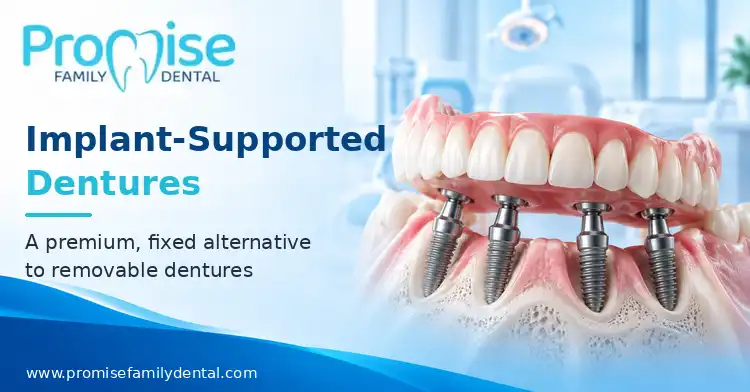
Instead of resting directly on the gums the way a traditional denture does, an implant-supported denture is anchored to a small number of implant posts placed in the jawbone, usually four to six per arch depending on the case. The denture then clips or snaps onto these implants, or in some designs is permanently fixed to them. Either way, the result is a prosthetic that no longer relies on suction or adhesive to stay put.
How Implant-Supported Dentures Compare to Traditional Dentures
The differences show up most in day-to-day use:
- Stability — implant-supported dentures don't shift or click while eating or speaking; traditional dentures can loosen over time as the jawbone changes shape
- Bone preservation — the implants stimulate the jawbone the way natural tooth roots do, slowing the bone loss that traditional dentures don't prevent
- Chewing ability — patients typically regain significantly more biting force compared to a traditional denture, making foods like apples or steak realistic again
- Comfort — no adhesive is needed, and there's less irritation from a denture rubbing against the gums
- Cost — implant-supported dentures cost more upfront than traditional dentures, though many patients find the difference worthwhile for the improvement in daily function
Implant-Supported Dentures vs. Traditional Dentures: Side-by-Side Comparison
Who Is a Good Candidate for Implant-Supported Dentures?
Implant-supported dentures tend to work well for patients who:
- Have lost most or all teeth in an arch and want a fixed or semi-fixed solution
- Have struggled with a loose or uncomfortable traditional denture
- Have enough remaining jawbone to support implants, or are candidates for bone grafting
- Are in good general health for a minor surgical procedure
- Want to slow the bone loss that comes with wearing a traditional denture long-term
Fixed vs. Removable Implant-Supported Dentures
Removable (Overdenture) Style
The denture snaps onto the implants and can be taken out by the patient for cleaning. This style is generally less expensive and easier to maintain, while still offering far more stability than a traditional denture.
Fixed (Permanent) Style
The denture is screwed or cemented onto the implants and only removed by the dentist. This option feels closest to natural teeth and generally allows for the strongest bite force, though it requires more diligent daily cleaning around the gumline.
What the Process Involves
- Evaluation — 3D imaging and a bone assessment to determine how many implants are needed and where they'll be placed
- Implant placement — the implant posts are surgically placed into the jawbone
- Healing period — typically a few months for the implants to fuse with the bone (a process called osseointegration)
- Denture fitting — once healed, the custom denture is attached to the implants and adjusted for bite and fit
Patients considering Dental Implants in Suffern for this kind of restoration usually start with a consultation to determine bone volume and whether any preparatory work, like grafting, is needed before implant placement.
What the Data Shows
Implants supporting an overdenture show survival rates comparable to implants used in other restorations, often in the 90–95% range at the 10-year mark, when properly maintained. (Source: NIH National Library of Medicine)
A Suffern Patient's Experience with Implant-Supported Dentures
Consider a patient in Suffern who had worn a traditional lower denture for years and found it increasingly loose as her jawbone gradually resorbed. Eating had become frustrating, and she'd stopped wearing the denture in social settings out of concern it would slip. After an evaluation showed adequate bone volume, she moved forward with four implants supporting a removable overdenture. Within a few months of healing and fitting, she reported eating normally again and no longer needing adhesive. Her experience reflects a tradeoff many patients considering Tooth Replacement in Suffern eventually face: stick with a denture that keeps loosening, or invest in the stability implant support provides.
Frequently Asked Questions
How long do implant-supported dentures last?
The implant posts themselves often last 15–20 years or longer with good care. The denture attached to them typically needs replacement or relining every 5–10 years due to normal wear.
Is the procedure for implant-supported dentures painful?
The implant placement is done under local anesthesia (or sedation, depending on the case), and most patients describe the recovery as manageable, similar to a tooth extraction. Some soreness and swelling for a few days afterward is typical.
Can I switch from a traditional denture to implant-supported dentures later?
Yes. Many patients who start with a traditional denture move to an implant-supported version later once they've decided the added stability is worth it. Your dentist will need to reassess your jawbone at that point, since bone volume can change over time.
Reviewed by Dr. Jacob John, DDS, clinical reviewer for Promise Family Dental.
Tired of a denture that won't stay put? Request an Appointment today, or call (845) 356-8844 to talk to our Suffern office about implant-supported dentures.
Article Author

Arobit
Blog Admin
Tags
Latest Posts
-
Smile Contouring: The Fastest, Least-Invasive Way to Refine Your Smile's Shape
-
Dental Implants in Suffern vs. Dentures vs. Bridges: Which Tooth Replacement Option Is Right for You?
-
Invisalign vs. Traditional Braces: An Honest Comparisons
-
What a "Top Dentist in Suffern" Listing Actually Means — and How to Verify It
-

5 Signs You've Found a Trusted Dentist for Your Family
Similar Posts
-
Invisalign vs. Traditional Braces: An Honest Comparisons
-
5 Signs You've Found a Trusted Dentist for Your Family
-
5 Things to Look For When Choosing a Family Dentist in Rockland County
-
Tooth Pain Relief: How to Manage a Toothache Before You Can See a Dentist
-
Why Having One Family Dentist for Everyone Saves Time and Improves Oral Health


