

Posted On: September 22, 2026
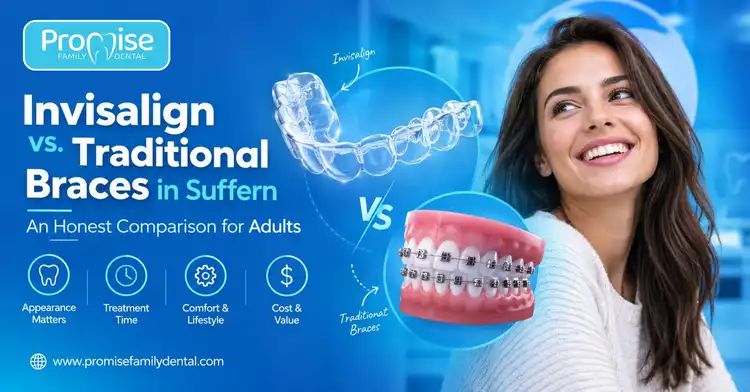
Invisalign vs. Traditional Braces: An Honest Comparisons
Choosing between Invisalign and traditional braces is one of the most common questions adult patients bring to their first orthodontic consultation. The honest answer is that neither option is universally better. The right choice depends on your bite, your daily habits, and the guidance of a dental specialist Suffern patients can rely on to evaluate their specific case. This guide breaks down how each treatment works, what adults tend to experience with each, and how to think through the decision with real information instead of guesswork.
Why the Right Dental Specialist Suffern Adults Choose Makes This Decision Easier
General dentists and orthodontic specialists both play a role in straightening teeth, but they aren't interchangeable for every case. A general dentist can often manage mild to moderate Invisalign cases. More complex bite corrections, significant crowding, or jaw alignment issues are typically better suited to an orthodontist, who completes additional postgraduate training beyond dental school.
Neither path guarantees a specific outcome, and the right fit depends on your individual evaluation. That's why the first real step in choosing between Invisalign and braces isn't picking a treatment at all. It's finding a provider who can examine your teeth, discuss your goals, and recommend the option that fits your specific situation.
How Invisalign Works
Invisalign uses a series of custom-made, clear plastic aligners that gradually shift teeth into place. Each set is worn for one to two weeks before being swapped for the next in the series, with the aligners applying gentle, continuous pressure along the way. Because the aligners are removable, patients can take them out to eat, drink, and brush their teeth.
That removability is also the biggest variable in how well Invisalign works. Consistent wear time directly affects whether treatment stays on schedule, which is why providers are upfront about the daily commitment involved before a patient starts.
How Traditional Braces Work
Traditional braces use metal or ceramic brackets bonded to each tooth, connected by a wire that your dentist or orthodontist adjusts at periodic visits. Because braces are fixed in place rather than removable, there's no daily compliance question. The brackets and wire are doing their job continuously, which is one reason braces are often recommended for more complex bite corrections.
The trade-off is visibility and some dietary restrictions during treatment, along with the periodic adjustment appointments needed to keep the wire tension on track.
Invisalign vs Traditional Braces: Comparing Cost, Timeline, and Visibility
In practice, the two options are closer than most people expect. Nationally, both treatments commonly fall in a similar overall price range, with the exact cost depending far more on case complexity than on which appliance is used. Treatment timelines follow a similar pattern: straightforward cases can finish in under a year with either option, while more involved corrections take longer regardless of the appliance.
Looking specifically at Invisalign vs braces for adults, a few extra considerations come into play that don't apply as much to younger patients. Adult cases sometimes involve previous dental work, gum health considerations, or a bite that's had years longer to develop its current alignment. A provider will factor all of this into a treatment recommendation.
Who Tends to Do Well With Invisalign
- Patients with mild to moderate crowding or spacing
- Adults who want a less visible option for professional or social settings
- Patients who are confident they can commit to consistent daily wear
- Those who prefer being able to remove the appliance for eating and brushing
Who Tends to Do Well With Traditional Braces
- Patients with more complex bite or jaw alignment needs
- Those who may struggle with the discipline required for removable aligners
- Cases that benefit from continuous, uninterrupted pressure
- Patients who prioritize a predictable schedule over discretion
What the Data Shows
A look at the broader numbers helps explain why more adults are exploring orthodontic treatment today, and what a realistic commitment looks like with each option.
Making the Decision With a Professional
Neither Invisalign nor traditional braces is the automatically "better" option. Each can improve alignment and support long-term oral health when it's matched to the right case. An in-person evaluation is the only reliable way to know which treatment fits your bite, your lifestyle, and your goals. Photos and general guides can only go so far in accounting for your specific teeth and jaw structure.
Doctors recommend wearing Invisalign aligners for 20 to 22 hours a day to stay on track with treatment timelines — a discipline factor worth weighing honestly before choosing between the two options. (Source: Invisalign/Align Technology)
Frequently Asked Questions
Do I need to see a specialist, or can my general dentist handle Invisalign or braces?
It depends on the complexity of your case. Many general dentists offer Invisalign for mild to moderate cases, while more involved bite corrections are often referred to an orthodontist. A dental specialist Suffern patients are referred to for these cases has completed additional training specifically in tooth movement and jaw alignment, which is worth asking about during your consultation.
Is Invisalign more expensive than traditional braces?
Not necessarily. National pricing for both options commonly falls within a similar overall range, and the bigger factor in your final cost is case complexity rather than which treatment you choose. Your provider can give you a specific estimate after an evaluation.
Can adults still get braces or Invisalign after age 40?
Yes. Orthodontic treatment isn't limited by age, and healthy teeth and gums can generally be moved at any stage of life. Adults considering treatment later in life may need some extra evaluation around gum health and any prior dental work, which your provider will assess during your consultation.
Reviewed by Dr. Jacob John, DDS, clinical reviewer for Promise Family Dental.
Find Out if Invisalign Is Right for You. Schedule Your Visit or call (845) 356-8844 to speak with our Suffern office.
Article Author

Arobit
Blog Admin
Tags
Latest Posts
-
What a "Top Dentist in Suffern" Listing Actually Means — and How to Verify It
-

5 Signs You've Found a Trusted Dentist for Your Family
-
5 Things to Look For When Choosing a Family Dentist in Rockland County
-
Tooth Pain Relief: How to Manage a Toothache Before You Can See a Dentist
-
Why Having One Family Dentist for Everyone Saves Time and Improves Oral Health
Similar Posts
-
5 Signs You've Found a Trusted Dentist for Your Family
-
5 Things to Look For When Choosing a Family Dentist in Rockland County
-
Tooth Pain Relief: How to Manage a Toothache Before You Can See a Dentist
-
Why Having One Family Dentist for Everyone Saves Time and Improves Oral Health
-
9 Dental Emergencies You Should Never Ignore


